
 We left Verden bright and early at 6:30 a.m to make the two
hour drive to the city of Rosendahl, where Klaus Balkenhol’s stable is located.
We left Verden bright and early at 6:30 a.m to make the two
hour drive to the city of Rosendahl, where Klaus Balkenhol’s stable is located.  in the field. He explained that
when their horses are three, they are broke to ride and live in the barn, but
they still go out together in the field for a couple hours a day.
in the field. He explained that
when their horses are three, they are broke to ride and live in the barn, but
they still go out together in the field for a couple hours a day. 
Klaus
emphasized how important it was to keep the horses happy and not to stress them
too much mentally or physically while they are young. Then we went over to the
barn where the older horses were stabled and introduced to every horse.
 This is where we met Anabel Balkenhol’s
Olympic mount, Dablino! You could tell that he was a bit overwhelmed by all of
us when we first walked up to the cross ties, but he warmed up quickly after a
couple sugar cubes!
This is where we met Anabel Balkenhol’s
Olympic mount, Dablino! You could tell that he was a bit overwhelmed by all of
us when we first walked up to the cross ties, but he warmed up quickly after a
couple sugar cubes!


 They were
encouraged to stretch down and over their backs throughout the warm up, and
they remained the same in balance and rhythm. They were also given a lot of
walk breaks compared to all the other trainers we observed on our trip. Judith
Balkenhol explained that “walk breaks keep the muscles from getting too tired,
which prevents injuries.” Klaus said he likes to approach each training day in
the way that he goes throughout his own day. In the beginning he needs time to
loosen up and plan what he needs to do, then he works, and then towards the end
of the day he needs to slow down and relax. In the same way, horses need to be
allowed to “wake up” before going to work. Then after work, it is just as
important to let them unwind at the end so that they are happy to return to
work the next day.
They were
encouraged to stretch down and over their backs throughout the warm up, and
they remained the same in balance and rhythm. They were also given a lot of
walk breaks compared to all the other trainers we observed on our trip. Judith
Balkenhol explained that “walk breaks keep the muscles from getting too tired,
which prevents injuries.” Klaus said he likes to approach each training day in
the way that he goes throughout his own day. In the beginning he needs time to
loosen up and plan what he needs to do, then he works, and then towards the end
of the day he needs to slow down and relax. In the same way, horses need to be
allowed to “wake up” before going to work. Then after work, it is just as
important to let them unwind at the end so that they are happy to return to
work the next day.
 On average, the Balkenhol stable has around twenty horses in
training. On a regular working day, the horses are ridden in the morning and
then hacked out later in the afternoon briefly. Saturday is an easy day, horses
only train for half an hour or so in the morning and are hand walked in the
afternoon. The horses have Sunday off and are only hand walked.
On average, the Balkenhol stable has around twenty horses in
training. On a regular working day, the horses are ridden in the morning and
then hacked out later in the afternoon briefly. Saturday is an easy day, horses
only train for half an hour or so in the morning and are hand walked in the
afternoon. The horses have Sunday off and are only hand walked.
 All of the horses were ridden straight and correct. Klaus
explained that when suppling the horse, you can always play and move the bit.
But the bit should only move millimeters in the horse’s mouth—that’s all it
should take. As Klaus was instructing Sarah on the horse that she was showing
tomorrow, he told her to “give rein” on the circle in the canter. “This is
where you test if you have the horse on your seat. If when he stretches, that
he stays balanced.” This is so important
because from the beginning the horse must learn to go to the bit, and the rider
should never have to pull back. Then, after about 20 minutes, Klaus got on
Sarah’s horse and we got to see the master at work! It was impressive to say
the least!
All of the horses were ridden straight and correct. Klaus
explained that when suppling the horse, you can always play and move the bit.
But the bit should only move millimeters in the horse’s mouth—that’s all it
should take. As Klaus was instructing Sarah on the horse that she was showing
tomorrow, he told her to “give rein” on the circle in the canter. “This is
where you test if you have the horse on your seat. If when he stretches, that
he stays balanced.” This is so important
because from the beginning the horse must learn to go to the bit, and the rider
should never have to pull back. Then, after about 20 minutes, Klaus got on
Sarah’s horse and we got to see the master at work! It was impressive to say
the least!

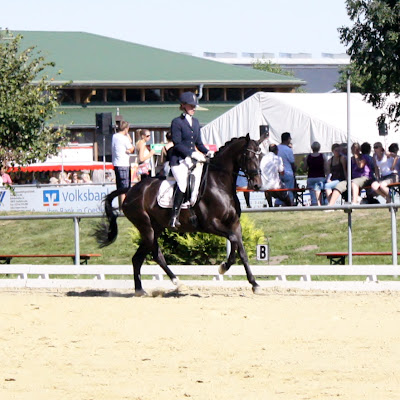
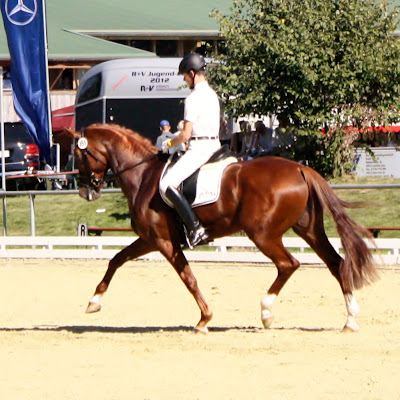
 We also got to watch Belli, (Anabel) ride a couple horses
today as well, including a fancy stallion that she is showing tomorrow. She is
a beautiful rider and has a lovely upper body position all the time.
We also got to watch Belli, (Anabel) ride a couple horses
today as well, including a fancy stallion that she is showing tomorrow. She is
a beautiful rider and has a lovely upper body position all the time.




 This is where we met Anabel Balkenhol’s
Olympic mount, Dablino! You could tell that he was a bit overwhelmed by all of
us when we first walked up to the cross ties, but he warmed up quickly after a
couple sugar cubes!
This is where we met Anabel Balkenhol’s
Olympic mount, Dablino! You could tell that he was a bit overwhelmed by all of
us when we first walked up to the cross ties, but he warmed up quickly after a
couple sugar cubes!
Judith showed us to the indoor arena where there were three
horses being schooled: a stallion, a 4-year-old gelding, and an 8-year-old
gelding that was returning to work. Klaus started the rider, Sarah Rogers, on
the lunge for about five minutes to make sure that the horse was settled. While
watching these three very different horses go, it was obvious that they were
very classically trained in dressage. In the warm up, they were quietly ridden
around the ring and were very relaxed, straight, and rhythmic.

 They were
encouraged to stretch down and over their backs throughout the warm up, and
they remained the same in balance and rhythm. They were also given a lot of
walk breaks compared to all the other trainers we observed on our trip. Judith
Balkenhol explained that “walk breaks keep the muscles from getting too tired,
which prevents injuries.” Klaus said he likes to approach each training day in
the way that he goes throughout his own day. In the beginning he needs time to
loosen up and plan what he needs to do, then he works, and then towards the end
of the day he needs to slow down and relax. In the same way, horses need to be
allowed to “wake up” before going to work. Then after work, it is just as
important to let them unwind at the end so that they are happy to return to
work the next day.
They were
encouraged to stretch down and over their backs throughout the warm up, and
they remained the same in balance and rhythm. They were also given a lot of
walk breaks compared to all the other trainers we observed on our trip. Judith
Balkenhol explained that “walk breaks keep the muscles from getting too tired,
which prevents injuries.” Klaus said he likes to approach each training day in
the way that he goes throughout his own day. In the beginning he needs time to
loosen up and plan what he needs to do, then he works, and then towards the end
of the day he needs to slow down and relax. In the same way, horses need to be
allowed to “wake up” before going to work. Then after work, it is just as
important to let them unwind at the end so that they are happy to return to
work the next day.  On average, the Balkenhol stable has around twenty horses in
training. On a regular working day, the horses are ridden in the morning and
then hacked out later in the afternoon briefly. Saturday is an easy day, horses
only train for half an hour or so in the morning and are hand walked in the
afternoon. The horses have Sunday off and are only hand walked.
On average, the Balkenhol stable has around twenty horses in
training. On a regular working day, the horses are ridden in the morning and
then hacked out later in the afternoon briefly. Saturday is an easy day, horses
only train for half an hour or so in the morning and are hand walked in the
afternoon. The horses have Sunday off and are only hand walked.
While watching those first three horses being trained, Klaus
told us to observe each of the young horses. He pointed out how each of them were
supple and straight. He stressed the importance of training horses according to
the training scale. Another thing that Klaus took a lot of time to talk about
was the walk. “It is really important
that the walk is always four beats”, Klaus said. It is so important that the
horse learns to remain pure in this gait that Klaus has all of his young horses
only walked on a long rein for the first three to four months of training. Over and over again, Mr. Balkenhol stated
that the walk was the most difficult gait to ride correctly. It is crucial to learn how not to disrupt the
horses’ natural gait because the walk is very important since you can feel if
the horse is truly stretching through to the bit or not.
 All of the horses were ridden straight and correct. Klaus
explained that when suppling the horse, you can always play and move the bit.
But the bit should only move millimeters in the horse’s mouth—that’s all it
should take. As Klaus was instructing Sarah on the horse that she was showing
tomorrow, he told her to “give rein” on the circle in the canter. “This is
where you test if you have the horse on your seat. If when he stretches, that
he stays balanced.” This is so important
because from the beginning the horse must learn to go to the bit, and the rider
should never have to pull back. Then, after about 20 minutes, Klaus got on
Sarah’s horse and we got to see the master at work! It was impressive to say
the least!
All of the horses were ridden straight and correct. Klaus
explained that when suppling the horse, you can always play and move the bit.
But the bit should only move millimeters in the horse’s mouth—that’s all it
should take. As Klaus was instructing Sarah on the horse that she was showing
tomorrow, he told her to “give rein” on the circle in the canter. “This is
where you test if you have the horse on your seat. If when he stretches, that
he stays balanced.” This is so important
because from the beginning the horse must learn to go to the bit, and the rider
should never have to pull back. Then, after about 20 minutes, Klaus got on
Sarah’s horse and we got to see the master at work! It was impressive to say
the least! 
When watching Klaus ride, there was never any restricting of the
horses’ neck. He didn’t make the horse hot by asking it to be extravagant.
Instead, he asked the horse to be relaxed, supple and through its back, and
then the horse seemed to dance. Mr.
Balkenhol stated that “when things get difficult, it is better to walk, and
then start again new.” If you were to observe the training at Balkenhol’s you
would not see anyone drilling movements. Everything is quite, relaxed, and
methodical.
 We also got to watch Belli, (Anabel) ride a couple horses
today as well, including a fancy stallion that she is showing tomorrow. She is
a beautiful rider and has a lovely upper body position all the time.
We also got to watch Belli, (Anabel) ride a couple horses
today as well, including a fancy stallion that she is showing tomorrow. She is
a beautiful rider and has a lovely upper body position all the time. 
It was
very interesting getting to meet her and to hear about the Olympics. She talked
a lot about what goes on behind the scenes at big shows with so many high profile
riders. She also talked about the spirit of everyone at the games, and said
that the American team always has the best team spirit and wonderful attitudes.
Before leaving, Klaus was kind enough to take a picture with him by his wife’s
beautiful garden. He even signed my copy of his book! It says “Best regards,
Have Fun, Good Luck!”

Sarah was kind enough to show us the way to the show grounds where we spent the rest of the afternoon watching some amazing horses! It was terrific! That night we meet with the Balkenhol’s again and had dinner at our hotel! Their family is so kind and down to earth. It was very nice to get to spend so much time with them and hear their stories! What an amazing day it was!


No comments:
Post a Comment